spoltopia

Splake = male brook trout + female lake trout, Spolt = Sparks + Holt

20 June, 2013

London


There are many ways to get from Wellington to Minneapolis, and Richard may have found the most disorienting of them all. Kristen had come back the week prior to feather the kohunga, and accompanied him onward to London for a conference presentation at the Narrative Medicine conference at Guy's Hospital. 

The usual sights were on the touristic menu, and we elected to pursue a "rise at noon" strategy to keep some semblance of U.S. time zone zeitgebbery. Anyway, there's plenty to do in London at 3 A.M.
Some odds and ends: Richard saw a fox in the Guy's/King's College courtyard (in the heart of London, metres from London Bridge!) We saw Joss Whedon's Much Ado About Nothing in Piccadilly as well as Noel Coward's Private Lives in the West End. Also had a fantastic Chinese dinner at the (literally and figuratively) hard to get into Four Seasons.
We also got the chance to head a bit out of the City to see Kew gardens and also visit some friends, Nick and Libby Hipkins, who we first met back in Wellington.

Not bad for a business trip, and we're certainly looking forward to coming back.

28 April, 2013

Nelson Lakes


Well, the last few entries have been a bit wordy, more random thoughts than travelogue as we wrap up here and prepare to return to MN for a while. But we still do get out, and after Richard crossed from Christchurch to Greymouth on the Tranzalpine railway, we serendipitously ran into friends Barbara, Guido and Linda in St Arnaud and had a fine evening of food, wine and conversation. Although the weather was a bit iffy, we managed to squeeze in a summit of Mt. Roberts (1421m) and a stroll along Lake Rotoroa. Next up, Madame Butterfly in Welly.


26 April, 2013

Relational models and Spoltopia: Invoking Our Better Angels


The following notes are inspired by a conversation we had about a section from Pinker’s “The Better Angels of our Nature,” (pp 759-65) which describes the continuum of domains that provide the context and “rules” for interpersonal interactions. Cultures and individuals vary widely over what is assigned to the sacred to what is seen as mere commerce. Moreover, notions such authority and distributive justice tend to change over time.  Because they are fluid and variable, mismatch between interpersonal expectations can produce comic faux-pas, but also tragic miscommunication. Whether we are consciously aware of it or not, significant energy is spent navigating these shifting sands, whether to find happiness or for survival. We choose to take this “snapshot” of these domains in our intentional Spoltopia because a compelling argument can be made that rationality, tolerance and transparency (as opposed to mere consistency) in these domains is a major force for pacification. More, however, than the mere avoidance of cross purposes, our goal is to build a conceptual framework through which to explore an adaptive and intentional approach to relationship building.

Sacred/tapu
This is the ‘thou shalt” and “thou shalt not” domain, but need not be embodied in religious articles of faith. As derived from practical enlightenment humanism, this domain covers any exposure that produces a lasting and visceral negative, such as fear, mistrust or disgust. Examples include violence, sexual/emotional infidelity, odors, (certain) bodily functions. These seem intuitive on paper, but are quite commonly breached in a series of “marginal violations”, leading an erosion of trust, safety and romantic love. Moreover, because of the indivisibility, by definition, of the sacred/tapu, disagreements on this level are nearly impossible to resolve without conflict and submission.

Authority ranking
This is essentially a hierarchical model, and has great utility in some contexts, especially where the highly ranked own both power and its consequences (eg “healthy” ward systems) or have “paid their dues” (eg mana for certain elders).  Without these legitimizing constraints, authority ranking can lead to authoritarian abuses of power (most religions, Abu Grahib, patriarchal marriage).
This schema is rarely used in Spoltopia, but provides a high value strategic orientation in situations where one individual transiently assumes a “leader” role due to advanced skill (spreadsheets vs haka). It should not impact on the overall relationship equilibrium (i.e. not produce a lasting asymmetry—see equality matching below).

Communal/shared
In Spoltopia, food and money are the best examples of “pooled” resources, for which no real or conceptual accounting is kept. We do, however, have numerous small zones of implicit quasi-ownership over items that could conceivably be communal (pairs of wool socks, hats, backpacks, sides of the bed, suitcases). Even though we are rarely consciously aware of this zone, we acknowledge its existence by prefacing use of these items with, “is it okay if I . . ?”, even though we know the answer will be a yes. However, “pure” communalism works better in the abstract and for plentiful resources. Communalism as an ever-expanding assumption can undermine autonomy and individualism.

Equality matching
In this model, explicit or implicit tabs are kept on the contributions of various members to ensure an equitable distribution of labor. A classic double bind in many relationships is that parties may feel aggrieved when they have to keep track of chores, but also feel cheated or overburdened when accounting is absent. It is in this domain that temperament most determines what will happen “naturally” when people meet over a shared cadre of tasks. This also means that conflicts in equality matching can be stubbornly resistant to change, as it requires a conscious exertion of will over an ego-syntonic reaction to a task (like a full rubbish bin or sink full of dishes). Conversely, super-collaborators, those with high innate ability to mentalize the states of others or those with highly developed observing egos will generally pair well with one another, divide tasks equitably and be unperturbed by transient minor disequilibria in workloads. However, even in these cases it is important to be able to express and resolve conflicts in the case of sustained asymmetry (say when a birth, disability or career change disrupts an existing equality matching system).

Market value/trade
In this model, negotiation is king and the more dispassionate, the better. Basically, this category covers everything that doesn’t fall into one of the above domains, which exist in part to cover situations unsuited to the commodity form. In terms of Spoltopia, this model would cover almost nothing inside the dyad, but is likely the most adaptive “default” way of interacting with the outside world. Far from dehumanizing, testing for “transactional” situations—where X amount of capital is exchanged for a good or service-- helps avoid fallacies and errors that lead to misallocation of monetary and emotional capital, such as chasing sunk-costs and personalizing contractual relationships. Where that doesn’t fit, the interaction can be steered into one of the other relational domains.

09 April, 2013

Wharenui: A Look Inside the Meeting House, Always from the Outside


Te Whare Marie Ki Puketiro is a specialist mental health service for Maori located in the lower North Island of Aotearoa (New Zealand). This setting includes elements of both a traditional marae and modern medical facilities. Here psychiatrists—none of whom are Maori-- practice alongside Maori cultural therapists, kaumatua (elders) and consumer consultants. In Aotearoa, those who care to look around--instead of only ahead-- cannot help but notice the fragmentation of the things that connect people to the language, the land and one another. Still, we are at home at Te Whare Marie, where the meeting house and clinical offices sit side by side, where we begin the day with acknowledgement, prayer and song. . . and checking the fax machine. And so it is that this gerrymandered mental health service picks up the pieces, mending with whatever is at hand: a prayer, a comforting word, a safe place to sit, a meal as often as a medicine.
The concepts of mental illness and wellness, as understood in Western culture and subsequent medical training, bear little resemblance to the increasingly lost ways of the tohunga. Because the work of Psychiatry, however skilled or virtuous, bears the indirect scars of colonialism, No pakeha (person of European descent) practicing psychiatry in a Maori setting possesses the honour, mana tupuna, to give formal oratory, or whaikorero, on Maori Mental Health. In our practice at Te Whare Marie, we struggle sometimes to reconcile the different processes by which Maori and pakeha "heal.” As we interrogate the space between these models through our narratives, I have asked our kaumatua to extend his korowai (cloak) so that we may move briefly under its shadow as we pass through the wharenui-- for its protection, and ours.
There are now many didactic resources available to define Maori words and concepts. This is not one of them. Rather, it is an attempt capture a sense of the healing narratives of those who work, train and seek care in this one small corner of Te Ao Marama.

* * *

Ko wai koe?[i] For the people of the land, te tangata whenua, the first question is where do you come from? The mountain, the river and the bloodlines that live and die upon them, these are the markers of one’s place in the larger world, te ao marama. Accordingly, a complex set of protocols, tikanga, governs the movement of strangers and visitors, manuhiri, onto the marae. The land of the marae and the meeting house that sits upon it, te wharenui, are sacred, living places. Here you must take care, inside the body of the tupuna (ancestors) for whom it is named.[ii] The ceremony of bringing new people onto the marae, or powhiri, is carefully orchestrated, and includes a call and response (karanga), challenge (wero, haka), song (waiata), invocation of the sacred (karakia) and speeches (whaikorero) of acknowledgement to the ancestors (tupuna) and purpose of the engagement (kaupapa). All of this before introductions, before each person in attendance shares whakapapa (geneology).
The powhiri serves the functions of welcome and familiarization, but also of safety. For Maori, this is not simply a matter of ensuring physical safety, but also on a spiritual plane moving from state of tapu to noa.  And while the ideas and functions of creating a safe interactional space are not unique to Maori, the powhiri serves an example of a uniquely Maori way of achieving a lowering of tensions so that those who were previously strangers may share food, disclose secrets and resolve conflicts. As such, it is a natural model for therapeutic engagement, and while for practical reasons we certainly do not powhiri each and every client who enters our service at Te Whare Marie, we routinely acknowledge this tradition with mihi whakatau, or introductions, in which karakia is offered, genealogy is shared (whakapapa) and kaupapa Maori mental health care is explained.
But just what is meant by kaupapa Maori mental health care? Maori models of narrative-based therapy, such as Te Tuakiri and Te Pounamu, do exist and are doubtless of great value. When practiced in mainstream clinics, however, they can feel awkward, or worse, segregated from the “normal” work of the clinic. This goes back to the broader question of place and process embodied in the wharenui, the powhiri and the question: ko wai koe? The clinic treatment room has no analogue in Maori tradition. Before method then, the answer to the question of defining kaupapa Maori starts with a setting and context in which culturally informed care feels natural. In its physical design, Te Whare Marie is a hybrid of marae and community clinic, and functions as both. In practice, there exists a collaborative tension between Maori and Western Medical concepts of illness and wellness. That is, it is a place where the possibility of cultural recovery is woven into every aspect of care. Still, evidence based medicine is practiced here. We do not have traditional healers (tohunga) or medicines (rongoa), but we do want to know if our clients have used—or are using—these.[iii] As the doctor, then, I have to accept that for many patients, mine is often the “alternative” medicine.
A more blunt answer was given when I posed the question to our cultural therapist, Tua Hekenui, two years ago. Without pause he stated, “kaupapa Maori means by Maori, for Maori.” I have come to understand over time that this is not meant to imply cultural exclusivity, as there are as many non-Maori as Maori working at Te Whare Marie. Rather, it refers to the vision and struggle for self-determination, tino rangatiratanga, in a world where the erosion of tikanga and cultural alienation are as real as any disease. The complex cultural détente and ongoing land and water issues, embodied in the 1840 Treaty of Waitangi, are beyond the scope of the present narrative, but the legacy of colonialism and wound it has left for many Maori would be difficult to overstate. Tua passed suddenly in April 2012, but not before giving me many treasures. Among these taonga were my first karakia, my pepeha and the beginning of a conversation that has continued since the day his body was taken from the wharenui at Te Whare Marie to the whenua of his tipuna in Taihape. It is my hope that this korero honors, and does not offend, his memory. But Tua would be the first to point out that it is not tika for me to speak alone about te whanau o Te Whare Marie. I have therefore humbly asked colleagues (kaimahi), elders (kaumatua) and clients (tangata whaiora) for their help.  Nga mihi nui.


[i] Literally, “what are your waters?”, and as good a place as any to comment on the use of Maori language, te reo, in this narrative. Acknowledging centrality of language and te reo preservation for Maori, along with the imperfect nature of translation of complex words, I have retained the Maori where I feel it is necessary and have avoided italicizing it. Te Wera’s whakatauki says it better than I ever could: Kei te aahua o te reo, Kei te wairua o te reo, Maa to taatou reo e mirimiri te wairua me te hinengaaro, (“There is healing within our language it is the way we speak and the spirit in which it is spoken. Let us use our language to massage our spirit, our soul and our emotions”)

[ii] Our whare, for example, is named after Rongo ma tane, atua (god) of peace.

[iii] We also have a tradition of very active cultural therapists, who use Maori concepts to guide many of our clients through losses, family conflict, life stresses and even culturally-bound transient psychoses. I am indebted to Dr. Allister Bush and Matua Wiremu NiaNia for sharing their manuscript of case studies with me.

08 April, 2013

Is Bitcoin the future, or a fad? That depends on what happens next.


On March 19th, a small insurance company in Wabash, Indiana with the unlikely name Beauchamp McSpadden posted an announcement on Bitcoinforum that it would be the “first insurance company to accept Bitcoin.” Bitcoin (BTC), an open-source peer-to-peer (PTP) electronic cash system launched in 2009, has been in the news recently after its value soared in the wake of the Cypriot banking collapse upon speculation that it may provide a secure alternative to fiat currencies. As far as I can tell, no news agency has reported the Beauchamp McSpadden announcement, and a cursory look at their website suggests that it may have been premature. In any case, my interest was piqued, as I have been thinking for the past few months about how the current changes in the healthcare marketplace, driven by the Patient Protection and Accountable Care Act (ACA), might create an opportunity for a unique and profitable partnership between Insurance Companies, states and bitcoiners. In brief, the growth of BTC, the expansion of Medicaid and insurance mandate under ACA and the advent of state-level health insurance exchanges (HIX) creates a risk/benefit equation that is potentially favorable to all. Although the majority of states have, for various reasons, elected to enact federal-level exchanges or partnerships, Minnesota is one of the 17 states to opt for a state-level exchange. One of the benefits of this arrangement is the opportunity to innovate in a manner that is consistent with the local business, political and economic environment. There are no hard data on the penetration of BTC in the Minnesota, and a quick online search reveals a very marginal uptake. However, the search also unearthed a newly formed interest group in the Twin Cities area, which may indicate a BTC using population poised to emerge. While BTC is currently in the news as a potential hedge against insecurity in the Central Banking sector, and perhaps poised on a bubble, I would argue that its survival depends on its broad adoption as a functional currency rather than as a commodity, such as precious metals. While the survival of BTC is by no means certain, the flow on effect of its recent turn in the headlines is a demonstrable increase in businesses that accept it and support its transmission. Perhaps more than the enthusiasts at Beauchamp McSpadden realize, Bitcoin is ideally suited as a payment device for the annual (or semi-annual) insurance premium, and one that insurance companies would do well to adopt. This is because a health insurance premium is essentially a periodic financial outlay that hedges against medical risk. Ideally, this is a modest payment in exchange for the promise of avoiding a potentially much larger expense in the event of injury or illness. For a bitcoiner, the BTC expenditure on an insurance premium now represents protection for his health and the health of his Bitcoin over the next year. If either fails, he has gained rather than lost (from an economic perspective). But what about the Insurance Companies? On the surface, there seems little reason to accept an “alternative” currency and the attendant risk. Indeed, if everyone started paying in BTC tomorrow, that would represent a significant risk. However, for a large insurer in a medium-sized statewide market such as Minnesota, the very small percentage of clients using BTC at the outset would expose them to miniscule risk, especially as BTC would not (at first) be used to pay for direct services, co-pays or deductibles. Moreover, the expansion of Medicaid under the ACA means that there is little likelihood that, either through bad luck or malice, an insurer would be exposed to a massive outlay (i.e. all of its heart transplants) on its BTC enrollees. In fact, the bitcoinner is statistically likely to be younger, more educated and healthier than the average enrollee—and perhaps only in the insurance market because under the ACA he now has to be. Besides, the BTC as payment experiment could be jettisoned just as easily as expanded. And for it to work, the bitcoiner needs to see the expenditure as desirable and useful; that is to say, a good value. For the Insurance Company, BTC has to make competitive sense; it has to broaden its reach within the sector as a whole. And while predicting the future is a fool’s errand, one can imagine the potential branding impact for the successful early adopter. After the global economic crisis, Insurance Companies are not as often mentioned in a favorable light, much less alongside such hallowed brands as Samsung and Apple. Something as simple as adding (and advertising) a “pay with Bitcoin” option to the company’s website and/or smart phone app could create not just buzz, but also real brand loyalty among a highly desirable demographic. Still, my guess is that, left to their own devices, big insurers will be slow to adopt BTC, seeing it as an uncertain business proposition, and an accounting and tax hassle to boot. This is where an enlightened “nudge” in the form of state involvement might play a role. For example, Minnesota could design one of the HIX selections with a “pay by BTC” option, then put supports in place to make it attractive to the company that supplies the specified product. This could be in the form of an offsetting tax credit for the first year. Even better, the state could promote “flow” of BTC by partnering with utility companies to subsidize favorable rates for electricity, sewage, gas and water paid by early-adopters of BTC. These supports may not even be necessary, but a show of government support in an age defined by partisan gridlock would mean quite a lot. In the end, I do not imagine that the “cool” factor alone will lure any of the large insurers into the Bitcoin marketplace. In spite of the broader issues surrounding state vs. non-state currencies, it may soon simply be good business to bring Bitcoin into the fold of payment options available to insurance companies and their enrollees. After all, getting paid is what it’s all about.

03 April, 2013

West Coast Ramble, part II: to Karamea

It seems like just yesterday that we returned form Spain, but here we are together again on the West Coast for the long Easter Holiday weekend. It was not all play, at least not right away, as Kristen was on call and we had a mountain of paperwork to get through in advance of our return to MN in June. Given that we were both still a bit lagged from the recent travels, it was actually nice to play with the espresso maker, snuggle in front of the big TV and watch movies all day while it rained outside.
But with the work done and the weather clear, we decided to ramble northward, and in so doing can now say that we've driven the entire length of the West Coast together.
We started at Truman Beach, which is very close to Punakaike Rocks, and were lucky enough to catch it at low (but rising!) tide.
Truman Beach
Onward then (and onward) we drove, eventually to the literal end of the road at the Heaphy trailhead just outside of Karamea. This area is remote even by NZ standards, and is home the the magnificent Kahurangi National Park. The trek across the ranges will have to wait until another day, but we did stop by the Oparara Arch (a daunting drive). The picture below shows the river flowing out below and the "mini arch" at the entrance of the 200 metre long passage, which is the "arch proper". I just went back and looked at a blog entry for a similar formation, Mangapouha Natural Bridge, which we saw during our 2008 tour of the King Country. At the time I described it as "impossible to photograph," which is as true here and now as it was there and then.
Oparara Arch
We decided to pop over to the trailhead for Mirror Tarn and were rewarded with a sighting of a pair of rare whio (blue ducks) lounging on the water's edge.
On the way back to Cape Foulwind, we stopped to visit the Denniston Plateau, which is the site of a famous old mining town where they used to send the coal down the mountain on what was essentially a mountainside roller coaster. Today, it is abandoned by people but quite popular with korimako (bellbirds). It is also a harsh but unique ecosystem, a niche where lichens and invertebrates have co-evolved for millenia. It is highly likely that this area will be given over to open pit coal mining in the near future, like nearby Stockton. Because it is not as lush or inviting to the human eye, Denniston is a bit of a litmus test for how one sees Aotearoa. Some see economic opportunity, while others see the loss of a precious and irreplaceable taonga.
Denniston Plateau
You can probably guess where we stand.

17 March, 2013

Andalusia


Gothic Cathedral (l) and Archivo de los Indios (r), Sevilla
Because our evening flight out of Aotearoa headed East across the International Date Line, 10 March 2013 carries the distinction of being both my longest day and my 44th birthday. Kristen and I had been living and working apart for 4 months, so the fortnight together in Andalusia was as much about falling asleep and waking up together as it was about exploring southern Spain (oh yeah, we also attended a conference on Bipolar).
The view from our window in Sevilla (Santa Maria Magdalena)
The flight, though epic in length, was without glitches. Most surprisingly, the bag we checked in Wellington was waiting for us 4 flights later in Sevilla. Perhaps the sheer duration of the journey helped, but for whatever reason our internal clocks adjusted quickly to local time.


Sevilla
As is our routine, we spent the first day in Sevilla exploring on foot and sussing out local and regional transport systems.  It was cool and wet that first day, and we discovered quickly that the fruit-laden orange trees along the boulevards and in the parks were more decorative then edible.
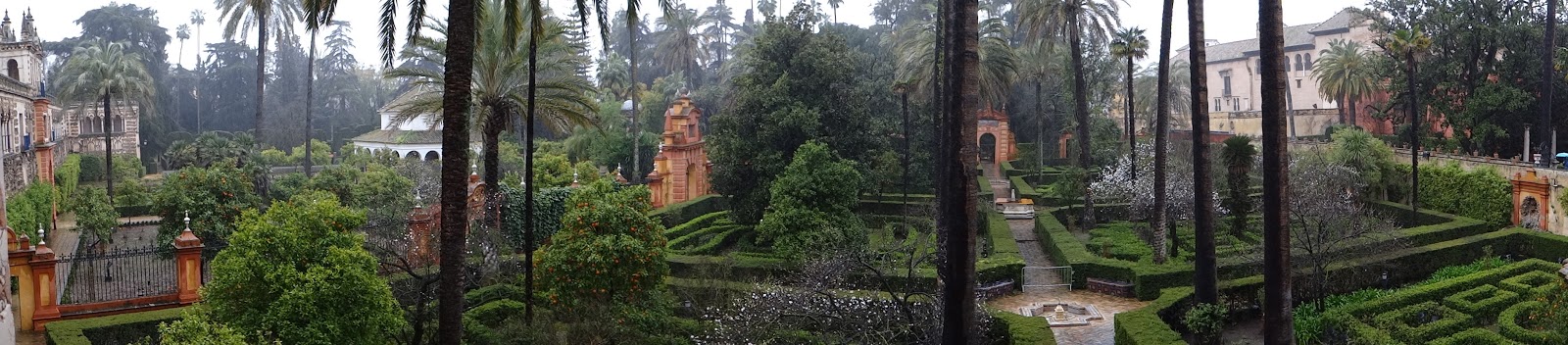
In any case, a rainy day is as good as any to explore the Alcazar. We didn't realize until later how lucky we were to avoid the crowds and long queues. As with the Alhambra, the level of detail is dizzying. 

Over the following week, we visited many of the other on the long list of "must do's" in this amazing city, including the imposing Plaza de Espana (which BTW Lawrence of Arabia tries to pass off as Britain's WWI Cairo HQ):
the massive gothic Catedral
 and the Hospital de la Caridad, whose chapel's simple facade
gives little indication of stunningly beautiful interior, including multiple seminal Murillo paintings:
Don Miguel Manara, who founded the Hospital to care for the needy, wrote:
The rich man is flooded by attentions
The poor man is submerged in misery
The monarch is soaked in flattery
And the shepherd is moored to grievous hardship
The remainder of our time was spent wandering the maze of streets, along the Guadalquivir River and into the Triana neighborhood. Most of these excursions involved a cheese, a cured meat and a fermented beverage-- Andalusia is, after all the birthplace of Tapas. Speaking of which, the first “out of town” activity we undertook was (of course!) a birding excursion. What does that have to do with “fermented beverages”?

Jerez
Well, we started our birding day in Jerez, which is heart of Spanish sherry production. So important, in fact, that the word “sherry” is itself nothing more than an Anglophone mispronunciation of Jerez. So before any serious birding could take place, a stop by the local Despacho de Vinos was naturally in order.
Our guide Stephan, a transplanted Scot and true polyglot, helped us explore the banks, fields, floodplains and salt marshes along the edge of the Donado Parque Nacional for birds. We stopped for a prodigious lunch at a small rural bodega, where the bread, olives, fish and wine were all locally produced (and cheap!). We pushed onwards to Bonanza, where the Gudalquivir empties into the Bahia de Cadiz, and the point from which Columbus set off on his third “Voyage of Discovery.” By the time we made it back to the Jerez station, the senoras were out for their constitutionals, the shadows were long and we were exhausted. Still, a successful day all around.

Cordoba
The clear, cool weather held for out trip the following day to Cordoba, where medieval fortress walls abut a vibrant and modern city. Because we arrived early and braved the (relative) cold, we had the old city pretty much to ourselves for a couple of hours. 
We made our way directly to the Mosque-Cathedral. The courtyard and bell tower, while beautiful, did little to prepare us for the amazing beauty of the interior. 
Wandering alone through this massive space while the pipe-organist played was one of the true highlights of this (or any) trip. 
The juxtaposition of Christian and Islamic architecture was not jarring in the least, an apt symbol of the unique religious harmony enjoyed by Cordoba’s medieval citizens. 
 One particularly striking element was the mirab, an alcove along the East wall, indicating the direction of Mecca. The inscription in Arabic above reads, “Believer, whatever your faith, let this sheath of fire grow within you.”
Crossing the Bajada del Puente and climbing the calahorra tower on the opposite bank of the mud-swollen Guadalquivir provided a clear view of the city and surrounding hills.
  We passed the balance of the morning wandering through the Jardin Botanico and Parque Zoologico, and spent siesta time wandering through the Alcazar de los Reyes Catolicos. The view from the watchtower provides an unrivaled “inside” view of Old Cordoba.

Cadiz
The rain returned at the weekend, but did not dampen our spirits during a day trip to Cadiz. Whether it was the coastal battery, the narrow old streets or the high end shopping juxtaposed with slightly seedy tourism, Cadiz reminded us a bit of Charleston. I think, in the end, Cadiz is an amazing city that probably suffered only by comparison against the three other extraordinary Andalusian cities we visited.


Granada
Our last city, Granada, is situated in the foothills of the Sierra Nevadas, which provided a dramatic background for our visit to the Alhambra.
Granada's old towns of Sacramonte and Albaycin are the birthplace of Flamenco and still retain a "gitano"(gypsy) feel. Wandering the streets at night was especially beautiful. This was by far the most hilly of the cities, and had a very vibrant feel to it. At the top of the main hill is the famous Alhambra, easily the most visited Moorish/Christian site in Andalusia. While the complex is massive and the location scenic, the architecture is actually quite average until you enter the Palacio Nazaries, whose scale and craftsmanship are truly beyond the ability of photos to capture. Here are some closer-in photos highlighting some of that magnificent detail:
To end this near-perfect day, we wandered over to the Generalife Gardens to watch the sun set over the Alhambra, then had an amazing dinner of "honey-ribs" at a local bodega (we had a couple of beers and some tapitas waiting for the cook to arrive at 8-ish, but is a country where breakfast usually doesn't get rolling unti 10-ish, this was not unexpected--and worth the wait).
The following day, we discovered a hidden gem just beyond the Alhambra. Unlike its crowded and touristy counterpart, the small but elegant Carmen de los Martires and its peaceful gardens invite slow, contemplative exploration. We also visited the Plaza de Toros, another surprisingly isolated and peaceful (when no bullfighting is going on) spot in the heart of Granada.