|
| Gothic Cathedral (l) and Archivo de los Indios (r), Sevilla |
Because our evening flight out of Aotearoa headed East
across the International Date Line, 10 March 2013 carries the distinction of
being both my longest day and my 44
th birthday. Kristen and I had
been living and working apart for 4 months, so the fortnight together in
Andalusia was as much about falling asleep and waking up together as it was
about exploring southern Spain (oh yeah, we also attended a conference on
Bipolar).
 |
| The view from our window in Sevilla (Santa Maria Magdalena) |
The flight, though epic in length, was without glitches.
Most surprisingly, the bag we checked in Wellington was waiting for us 4
flights later in Sevilla. Perhaps the sheer duration of the journey helped, but
for whatever reason our internal clocks adjusted quickly to local time.
Sevilla
As is our routine, we spent the first day in Sevilla
exploring on foot and sussing out local and regional transport systems. It was cool and wet that first day, and we
discovered quickly that the fruit-laden orange trees along the boulevards and
in the parks were more decorative then edible.
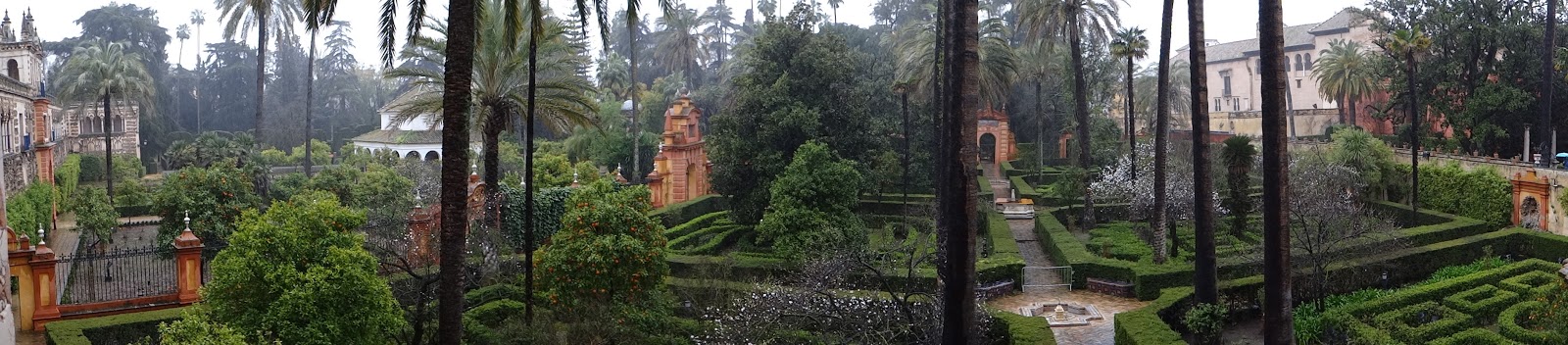
In any case, a rainy day is as good as any to explore the Alcazar. We didn't realize until later how lucky we were to avoid the crowds and long queues. As with the Alhambra, the level of detail is dizzying.
Over the following week, we visited many of the other on the long list of "must do's" in this amazing city, including the imposing Plaza de Espana (which BTW
Lawrence of Arabia tries to pass off as Britain's WWI Cairo HQ):
the massive gothic Catedral
and the Hospital de la Caridad, whose chapel's simple facade
gives little indication of stunningly beautiful interior, including multiple seminal Murillo paintings:
Don Miguel Manara, who founded the Hospital to care for the needy, wrote:
The rich man is flooded by attentions
The poor man is submerged in misery
The monarch is soaked in flattery
And the shepherd is moored to grievous hardship
The remainder of our time was spent
wandering the maze of streets, along the Guadalquivir River and into the Triana
neighborhood. Most of these excursions involved a cheese, a cured meat and a
fermented beverage-- Andalusia is, after all the birthplace of Tapas. Speaking of which, the first “out of town” activity we
undertook was (of course!) a birding excursion. What does that have to do with
“fermented beverages”?
Jerez
Well, we started our birding day in Jerez, which is
heart of Spanish sherry production. So important, in fact, that the word
“sherry” is itself nothing more than an Anglophone mispronunciation of Jerez.
So before any serious birding could take place, a stop by the local Despacho de
Vinos was naturally in order.
Our guide Stephan, a transplanted Scot and true polyglot,
helped us explore the banks, fields, floodplains and salt marshes along the
edge of the Donado Parque Nacional for birds. We stopped for a prodigious lunch
at a small rural bodega, where the bread, olives, fish and wine were all
locally produced (and cheap!). We pushed onwards to Bonanza, where the
Gudalquivir empties into the Bahia de Cadiz, and the point from which Columbus
set off on his third “Voyage of Discovery.” By the time we made it back to the
Jerez station, the senoras were out for their constitutionals, the shadows were
long and we were exhausted. Still, a successful day all around.
Cordoba
The clear, cool weather held for out trip the following day
to Cordoba, where medieval fortress walls abut a vibrant and modern city. Because
we arrived early and braved the (relative) cold, we had the old city pretty much to
ourselves for a couple of hours.
We made our way directly to the
Mosque-Cathedral. The courtyard and bell tower, while beautiful, did little to
prepare us for the amazing beauty of the interior.
Wandering alone through this
massive space while the pipe-organist played was one of the true highlights of
this (or any) trip.
The juxtaposition of Christian and Islamic architecture was
not jarring in the least, an apt symbol of the unique religious harmony enjoyed
by Cordoba’s medieval citizens.
One particularly striking element was the
mirab, an alcove along the East wall, indicating the direction of Mecca. The inscription in Arabic above reads, “Believer, whatever your faith, let this sheath of fire grow within you.”
Crossing the Bajada del Puente and climbing the calahorra tower on the opposite bank of the mud-swollen Guadalquivir provided a clear view of the city and surrounding hills.
We passed the balance of the morning wandering through the Jardin Botanico and Parque Zoologico, and spent siesta time wandering through the Alcazar de los Reyes Catolicos. The view from the watchtower provides an unrivaled “inside” view of Old Cordoba.

Cadiz
The rain returned at the weekend, but did not dampen our spirits during a day trip to Cadiz. Whether it was the coastal battery, the narrow old streets or the high end shopping juxtaposed with slightly seedy tourism, Cadiz reminded us a bit of Charleston. I think, in the end, Cadiz is an amazing city that probably suffered only by comparison against the three other extraordinary Andalusian cities we visited.
Granada
Our last city, Granada, is situated in the foothills of the Sierra Nevadas, which provided a dramatic background for our visit to the Alhambra.
Granada's old towns of Sacramonte and Albaycin are the birthplace of Flamenco and still retain a "gitano"(gypsy) feel. Wandering the streets at night was especially beautiful. This was by far the most hilly of the cities, and had a very vibrant feel to it. At the top of the main hill is the famous Alhambra, easily the most visited Moorish/Christian site in Andalusia. While the complex is massive and the location scenic, the architecture is actually quite average until you enter the Palacio Nazaries, whose scale and craftsmanship are truly beyond the ability of photos to capture. Here are some closer-in photos highlighting some of that magnificent detail:


To end this near-perfect day, we wandered over to the Generalife Gardens to watch the sun set over the Alhambra, then had an amazing dinner of "honey-ribs" at a local bodega (we had a couple of beers and some tapitas waiting for the cook to arrive at 8-ish, but is a country where breakfast usually doesn't get rolling unti 10-ish, this was not unexpected--and worth the wait).
The following day, we discovered a hidden gem just beyond the Alhambra. Unlike its crowded and touristy counterpart, the small but elegant Carmen de los Martires and its peaceful gardens invite slow, contemplative exploration. We also visited the Plaza de Toros, another surprisingly isolated and peaceful (when no bullfighting is going on) spot in the heart of Granada.